Direct answer: CNC machining cost for a large welded part has no dependable universal per-hour or per-part price. The cost depends on which work is included: preparation and programming, handling and setups, cutting time, tooling, inspection, and any one-time fixture or first-article work. A simple unit-cost estimate adds recurring work per part to the appropriate share of one-time and per-batch costs. If the buyer needs a completed welded structural component, material, fabrication, finishing and delivery must be scoped separately from machining. A real price requires the controlled drawing, starting weldment condition, inspection requirement and order quantity.
First decide which cost is being estimated
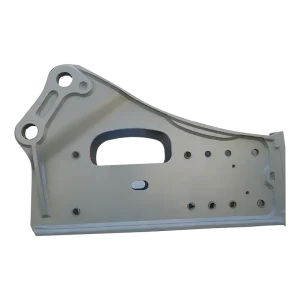
“How much does CNC machining cost?” can describe two very different purchases. One buyer supplies an accepted welded blank and pays a shop only to machine specified faces, holes and bores. Another buys a finished structural component from a manufacturer that procures steel, fabricates and welds the frame, machines its interfaces, inspects it, finishes it and prepares it for delivery. The second price cannot be explained by machining hours alone.
This distinction is especially relevant to construction and mining equipment. WLD’s construction machinery structural components include excavator assemblies that are substantial weldments rather than small blocks of stock material. For these products, the state of the structure before machining and the definition of the completed part are part of the commercial boundary. An estimate should name that boundary before any calculation begins.
For machining-only work, the starting component needs an agreed condition: who owns the blank, what material and weld condition it has, whether machining stock remains on required surfaces, and what happens if it is outside an accepted condition. For a delivered OEM component, fabrication and machining can be planned as one manufacturing route, but their costs should still be distinguishable. This makes the eventual unit price easier to explain when the drawing or batch schedule changes.
What goes into the CNC machining cost of a large part?
The cutting pass visible on a machine is only one part of the operation. A large weldment must often be moved into position, supported, located against datums, clamped without introducing unacceptable distortion, probed or measured, then machined. If a second orientation is needed, the handling and alignment sequence begins again. Each additional setup can consume capacity even when the actual metal-removal time is short.
A useful estimate separates the work by when it occurs:
| Cost behavior | Typical work | How it enters the estimate |
| One-time project work | Initial process planning, CNC programming, dedicated fixture development, proving and agreed first-article activity | Charged separately or allocated over an agreed volume; it does not disappear when a repeat unit is ordered. |
| Per-batch work | Fixture installation, program or machine preparation, initial alignment and batch-specific inspection setup | Allocated across the quantity in that actual batch, not automatically across an annual forecast. |
| Per-part work | Load and locate the part, machining cycles, tools and consumables, in-process checks, unloading and routine final inspection | Varies with the work required by each acceptable part. |
| Condition-dependent work | Approved correction, unusual stock removal, additional measuring, or rework after a nonconformance | Define its acceptance and payment boundary; it should not be silently assumed in every normal unit. |
These are cost behaviors, not universal line items in every supplier quotation. A manufacturer might include some setup in its unit price, charge a fixture separately, or absorb routine inspection in its standard process. What matters to a buyer is whether the estimate reflects the actual process and whether an item is being counted twice.
A simple CNC machining cost calculation per part
A useful first-pass model separates the recurring unit work from the costs spread across a project and a production release:
Estimated machining cost per part = recurring machining and routine inspection per part + (one-time project cost ÷ agreed volume) + (setup cost per batch ÷ actual batch quantity)
The recurring term includes the normal handling and machining of each part. The one-time term might cover a dedicated fixture, programming and first-article proving. The batch term reflects the fact that a machine and fixture must be prepared each time a production lot is released. If the supplier charges the one-time items separately, remove that allocation from the unit figure and show those charges beside it. If finishing or logistics are in the contract, add them under the appropriate complete-part cost heading rather than relabeling them as CNC machining.
Illustrative arithmetic only: Suppose a hypothetical project has 120 abstract cost units of one-time work, 30 units of setup for each batch, and 40 units of recurring machining per acceptable part. A single part in one batch works out to 190 cost units: 120 + 30 + 40. A ten-part batch, assuming the same project and one setup, is 55 per part: 12 + 3 + 40. A 50-part release in one batch is 43 per part: 2.4 + 0.6 + 40. These units are deliberately not currency, an industry rate or a WLD quotation; they show only how an unchanged manufacturing scope behaves at different quantities.
Now change the release pattern without changing the annual quantity. If those 50 parts arrive in five ten-part batches, the batch setup contribution is 3 units per part instead of 0.6. The resulting 45.4 cost units per part are higher than the single-batch estimate. This is why “50 pieces a year” does not by itself describe the economics of a 50-piece production run. The model also assumes the same fixture, drawing, yield and cycle time throughout; if any of those change, recalculate the inputs.
Why an hourly machine rate cannot answer the whole question
Searches for cnc machining cost per hour often treat hourly machine rate as the price of a part. An hourly rate is one input to a cost model. The number of chargeable machine hours depends on toolpath, cutting conditions, access, metal removal, setup and how the shop accounts for non-cutting work. A lower hourly rate can be outweighed by more setups or longer cycles. Equally, a more capable setup may reduce handling and cutting time without changing the finished part’s requirements.
Imagine two process plans for the same welded frame. In one, the reference surfaces can be reached and measured after one robust setup. In the other, the frame must be turned and re-established against its intended datum more than once. The estimate changes because additional crane moves, locating, clamping and verification occupy machine and personnel time. The actual number of setups cannot be inferred from a website photo or from the outer dimensions alone; the drawing, accessible interfaces and proposed fixture determine it.
Cutting time itself depends on material, stock left after welding, the size and location of the surfaces to be finished, tolerance and finish requirements, tool choice and allowable cutting conditions. Tooling that permits a more stable operation may cost more per insert while reducing machine time or scrap risk. The right cost question is therefore how long the approved process route takes to make an acceptable component, not simply which shop lists the lowest hourly rate.
How does a welded blank change the machining estimate?
The weldment is not a perfectly shaped billet waiting to be cut. Welding can move surfaces and alter the relationship between intended machining datums and the interfaces that must eventually mate with other assemblies. The estimator needs to know the condition in which the welded part arrives, what stock remains for machining and how it will be supported during cutting and measurement.
Excess stock on large pads or bosses increases material removal and may require an additional roughing pass. Uneven stock has another consequence: time can be lost establishing a safe starting plane before the finishing pass. Too little stock at a critical mounting face is a different problem. The shop cannot manufacture missing material through a revised toolpath; it must investigate an approved recovery route, repair decision or rejection. These are reasons to define the acceptable blank condition, not reasons to assume every weldment needs the same allowance.
Datum choice changes cost as well as accuracy. If the part is located from a feature that moves unpredictably during welding, the operator may spend more time establishing each part and may still lose consistency across a batch. A stable locating concept can make the per-part route repeatable, while an undefined concept can turn an apparently cheap quote into repeated fitting and measurement. Any intermediate stress-management treatment should be included only when the actual approved process calls for it; it should not be inserted as a universal step for all welded frames.
Which inspection costs are necessary?
Large-part inspection can range from routine checks of a few machined interfaces to a documented first article and extensive dimensional reporting. The cost is driven by what needs to be demonstrated, how the part must be supported, which characteristics are critical to assembly and how often they must be recorded. The more meaningful question is whether the inspection plan proves that the machined structure will perform its intended mating function.
For instance, a hole pattern, mounting pad and bore may each pass an isolated size check yet still be wrong relative to the reference used at assembly. If the drawing controls those relationships, inspection needs to preserve that common datum logic. Conversely, requiring the same exhaustive report on every repeat part, where a validated process and an agreed sampling plan would suffice, may add cost without improving the decision. The buyer and manufacturer should agree the acceptance evidence for prototype, first article and repeat production before treating an inspection estimate as comparable.
WLD’s existing discussion of why large-part CNC machining quotes differ for the same drawing addresses how inconsistent inspection and scope assumptions create quote gaps. The focus here is narrower: decide which checks are needed for the part, then assign their one-time, per-batch or per-part cost correctly.
Example: costing the machined interfaces of an excavator lower frame
WLD describes its Excavator Lower Frame as a welded support structure containing longitudinal members, an X-shaped frame and a slewing-support mounting area. It is a useful product context for a cost model because structural fit depends on relationships among interfaces, not simply on the size of a rectangular piece of steel. The following is an analytical example, not a claim about WLD’s actual part routing or price.
Suppose an OEM drawing specifies machined mounting surfaces and holes on such a frame. The estimate starts by defining who supplies the welded structure and what condition it must be in before machining. Engineering then identifies which surfaces require a common datum, how the frame can be supported and reached, whether it can be completed in one orientation or needs more, and what must be measured at the end. Programming or a dedicated fixture is a project-level cost; preparing the machine for a release is a batch cost; handling, cutting and routine checks are unit-level costs.
If the frame arrives with inconsistent stock at the mounting surface, the nominal drawing remains the same but the normal machining route may not be repeatable. The manufacturer may need more alignment time, an approved change in the blank or a decision on out-of-condition material. The estimate should show the cost of a defined normal route and state how departures from the accepted starting condition are handled. That is more informative than attaching a generic hourly machining price to the product photograph.
What changes a preliminary estimate into a project price?
A preliminary cost model is useful for understanding the scale and structure of the work. It becomes a defensible quotation when the drawings and production assumptions are sufficiently defined to estimate a real process. The essential inputs are the current drawing or model, material and supplied-weldment scope, acceptable incoming condition and machining stock, critical interfaces and tolerances, required inspection evidence, target quantity per release and forecast repeat pattern.
WLD is an OEM manufacturer of heavy machinery structural components. For buyers sourcing a complete part, the discussion should also specify whether steel supply, welding, any agreed intermediate treatment, surface finish, protection and delivery are included in the finished-component price. For machining-only work, the starting blank’s ownership and condition have to be unambiguous. These boundaries help WLD evaluate a realistic route; they do not imply that the company publishes an off-the-shelf CNC machining rate.
Cost the actual component. Share the controlled drawing, starting-part condition, critical machined interfaces, inspection requirements and planned batch size through
WLD’s contact page. A project-specific review can separate one-time preparation, recurring machining and the wider structural-component supply scope.
Frequently asked questions
How much does CNC machining cost per hour for a large welded part?
No single hourly figure can answer the completed-part question. A rate must be combined with a process-specific estimate of machine occupancy and with programming, setup, handling, tooling and inspection as applicable. The quote should also specify what that hourly rate includes before it is compared with another rate.
Does a larger order always reduce CNC machining cost per part?
Spreading one-time work across more accepted parts generally lowers that component of unit cost. Recurring handling and cutting remain, and each production release may bring another setup. Changes in the drawing, batch pattern or starting weldment condition can offset the expected saving.
Is welding included in CNC machining cost?
Usually it is a separate manufacturing scope unless the supplier is quoting a completed welded and machined structural component. Confirm whether material, fabrication, machining, inspection, finish and delivery are all included before interpreting a unit price.
Can an online CNC machining cost calculator price an excavator frame accurately?
It may help organize assumptions, but a calculator that knows only material volume and machine hours cannot establish a large weldment’s actual datum strategy, lifting needs, setup count, stock condition or acceptance evidence. Use it for a preliminary model, then verify the production route against the drawing and part condition.