If you’re searching for the best CNC machining supplier for construction, mining, or lifting machinery, you probably need parts that fit, hold tolerance, and arrive on time without overpaying. The short answer is that no single supplier wins for every part. The right choice depends on your part family, batch size, and whether the supplier can prove its claims with documents.
This article gives you a sourcing shortlist built around that logic. We start by matching machine type (conventional, universal, or CNC milling) to your parts, then walk through supplier fit for construction structural and hydraulic parts, mining wear parts, drilling components, crushing and screening wear parts, and lifting equipment where certification comes first. We close with a hypothetical quote comparison that shows why the lowest unit price often becomes the most expensive option.
Best CNC Machining Suppliers: Match Machine Type to Part Family First
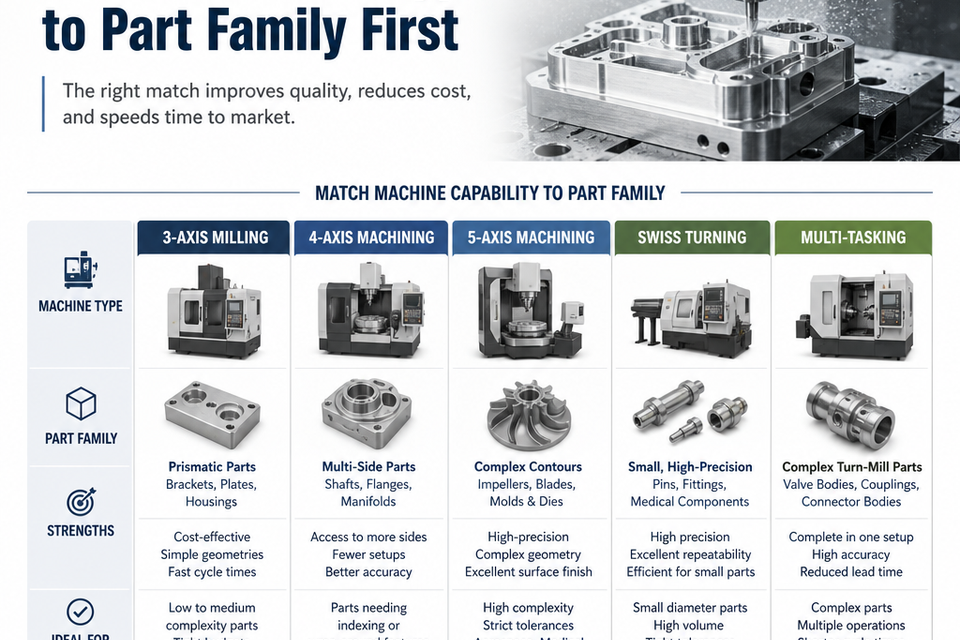
Illustration for Best CNC Machining Suppliers: Match Machine Type to Part Family First
Match the machine type to the part family first, then compare suppliers. A supplier with the lowest quote can still cost you more if its machines don’t suit your part. Our rating for this selection-first approach: 4/5. It keeps you from locking capex into the wrong machine.
Work through three questions before you request quotes:
- Part complexity: Simple cuts suit conventional mills. Helical or angled cuts need a universal mill with a swiveling table. Contoured, multi-face, or tight-tolerance parts point to CNC.
- Batch size: One-off or repair work tolerates manual setup. Repeat batches favor CNC, because programs and fixtures repeat.
- Operator skill: Conventional mills depend on the operator’s hands. CNC moves that skill into programming and setup.
Shaping is a niche option for short linear cuts on small parts. It rarely justifies OEM-scale capex.
Pros: Clear selection logic keeps you from buying CNC capacity for a part a conventional mill runs well. Cons: Many suppliers lead with CNC regardless of fit. Ask which machine will run your part and why.
Low quotes can also hide costs. Consider this hypothetical: two suppliers quote the same bracket. Supplier A quotes $30 per part. Supplier B quotes $38. A has a 12% tolerance rework rate and adds an $800 expedite fee per batch to cover lead-time variance. B has a 2% rework rate and no expedite fee. Each reworked part costs $25.
- 50 parts: A costs $49.00 per part. B costs $38.50.
- 200 parts: A costs $37.00 per part. B costs $38.50.
- 500 parts: A costs $34.60 per part. B costs $38.50.
The cheaper supplier wins only at volume. At 50 parts, rework and expediting erase the discount. Also ask each supplier for spare-parts lead times on its machines, because downtime often costs more than the unit price.
Construction Machinery OEM Suppliers: Structural Castings and Hydraulic Components
Rating: 4/5. Established structural and hydraulic suppliers fit OEMs that build frames, booms, and hydraulic manifolds, where weld quality and fatigue life drive field reliability.
Why they earn the rating:
- Established suppliers often hold weld procedure qualifications and can show material traceability. That paper trail matters when a boom fails in the field.
- Machining capacity for large parts cuts subcontracted operations. Fewer hand-offs mean fewer chances for datum errors between shops.
Tradeoffs:
- Pro: Strong structural track record, and these suppliers are easier to audit.
- Con: Lead times stretch during peak construction-cycle demand.
- Con: Minimum order quantities can run high for smaller OEMs.
Example: A hydraulic manifold needs drilled ports and faced sealing surfaces after welding. A supplier that machines the block in-house completes both in one flow. Otherwise, the block crosses two shops before it ships.
Verify before awarding:
- Weld procedure specifications, matched to your base materials and joint designs.
- Material test certificates, traceable to the heat or lot used for your parts.
- Fatigue test data on comparable geometries, not generic material sheets.
Request these documents before you compare prices.
Mining Machinery Suppliers: Wear Parts and Heavy Castings
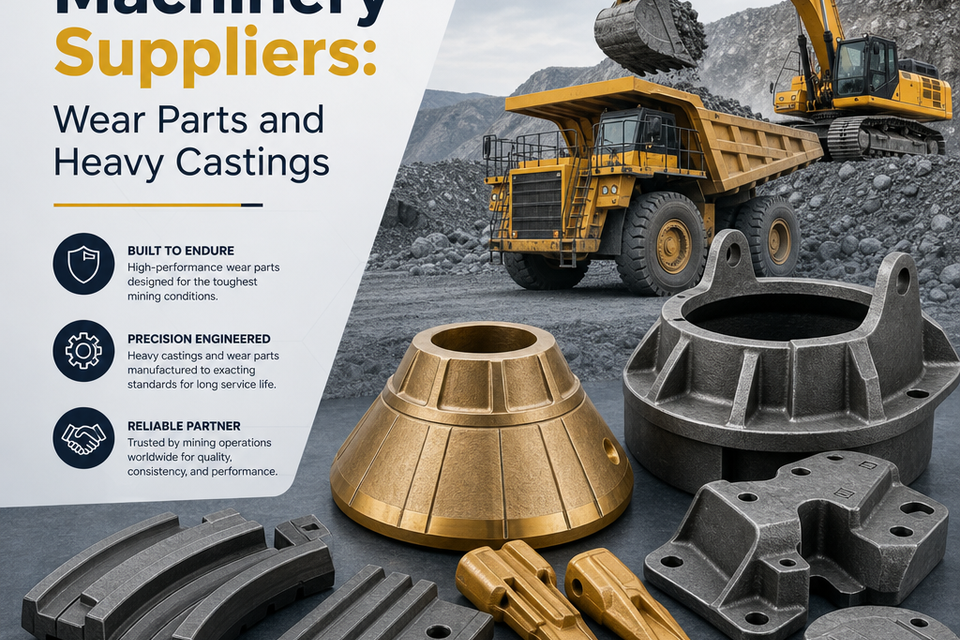
Illustration for Mining Machinery Suppliers: Wear Parts and Heavy Castings
Best for: Operations that need liners, wear plates, and large castings on predictable replacement schedules.
Short answer: Buy from these suppliers when you can verify batch quality. Rating: 3.5/5. The parts last, but casting lead times are long and quality varies sharply between foundries.
Why foundry choice matters: Heat treatment drives wear life. Foundries with in-house heat treatment reduce variability across batches because one team controls the full process. Outsourced treatment adds another handoff where results can drift.
Pros
- Durable parts with documented wear performance
- Wear-life data helps you set maintenance budgets in advance
Cons
- Long casting lead times make stock planning essential
- Quality differs widely from one foundry to the next
Verify before you order
- Request a hardness report for the batch that ships to you, not a sample certificate.
- Ask for wear-life history from comparable sites with similar ore and throughput. Then contact one of those sites directly.
- Get a written spare-parts stocking commitment with a stated lead time.
Some buyers treat wear data as sales material. However, a supplier that will name references and back them with batch records is making a claim you can test.
Drilling Machinery Suppliers: Spindles, Heads, and Rig Components
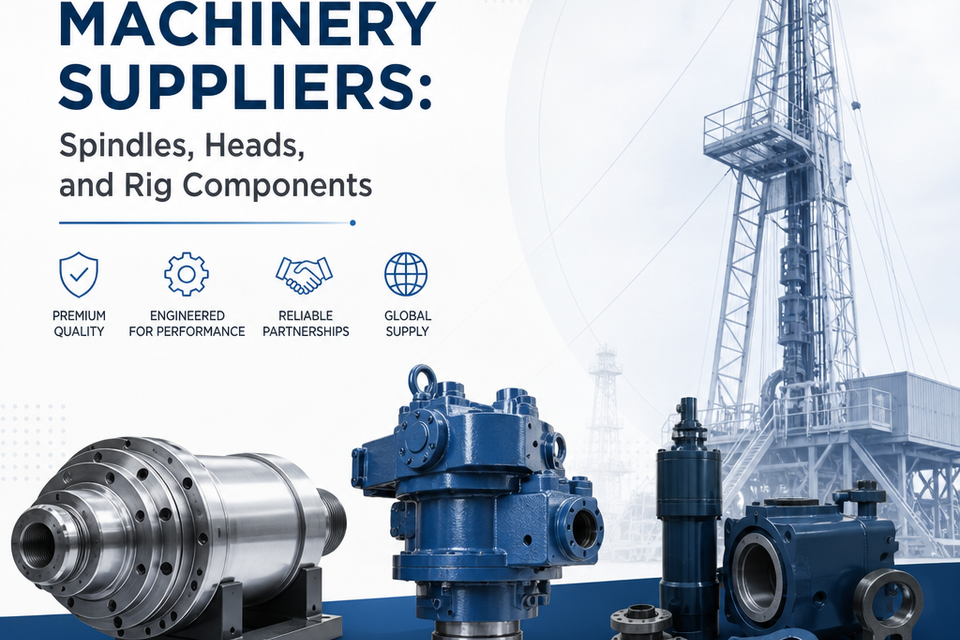
Illustration for Drilling Machinery Suppliers: Spindles, Heads, and Rig Components
Short answer: Pick suppliers who measure runout and balance on every spindle and head assembly. Those records prevent field vibration failures, which cost far more than a lower quote saves.
This suits OEMs building drill heads, spindle assemblies, and mast components that need rigidity and tight runout control.
- Balancing and runout equipment: Catches vibration problems before the rig ships.
- Bearing and seal sourcing: Drives service life. Ask for the bearing brand and grade in writing, and confirm a replacement source.
Pros: Precision-focused capability with clear acceptance tests. Cons: Specialized parts mean smaller supplier pools and longer qualification cycles, so start sourcing early. Rating: 4/5
Verify before you sign:
- Runout and balance reports for each assembly, not a sample.
- Bearing supplier identity, confirmed in writing.
- Acceptance test records tied to serial numbers.
Hypothetical scenario: A mid-size fabricator weighs owning, leasing, or buying a drilling cell for OEM work. Before comparing quotes, it fills in these fields:
- Purchase price: ______
- Annual lease payments: ______
- Annual depreciation: ______
- Annual maintenance: ______
- Downtime hours x cost per hour: ______
- Resale value at end of term: ______
Crushing and Screening Machinery Suppliers: Wear-Part Continuity
The short answer: judge crushing and screening suppliers on how reliably they keep wear parts flowing, not on frame specs alone. Wear parts drive recurring spend and unplanned downtime.
Standardized wear-part interfaces let you stock fewer SKUs. Suppliers that offer spare-part cross-reference or reverse-engineering keep older machines running after the original maker stops supporting them.
Pros
- Strong aftermarket potential
- Predictable wear-part consumption, which makes reorders easier to plan
Cons
- Counterfeit or non-matching wear parts are common in low-cost channels
Verify before you buy:
- Dimensional drawings for each wear part, checked against your current liners and decks
- Material certificates for each production batch
- A written parts-availability commitment in days, not a “typical lead time”
Example: Suppose a plant runs jaw crushers with worn cheek plates. If a supplier’s drawings don’t match the original profile, the new plates may fit poorly and wear unevenly. Order one trial set before signing a multi-year contract.
Start selection from throughput, material hardness, and site conditions, since these set wear rate. Treat this as a working checklist, not a proven ranking.
Recommendation: 3.5/5. Best for OEMs and plant builders that need frames, screen decks, and replaceable wear components with dependable supply. Less suited to buyers who only chase the lowest unit price.
Lifting and Handling Machinery Suppliers: Certification First
Choose lifting and handling suppliers that prove certification before you compare prices. For OEMs building hoists, gantries, and handling frames, safety certification and load ratings decide whether a product can enter the market at all.
Documented load testing and classification reduce compliance risk. Clear load-rating data also speeds buyer and insurer approval.
Verify these three documents first:
- Load test reports that show the rated capacity and the test load applied.
- Classification to a recognized standard, such as ISO 4301 for cranes.
- CE or equivalent declarations of conformity.
Request originals, not summaries. Confirm that the rated load on the report matches the nameplate and datasheet.
Pros: Established suppliers usually provide compliance-ready documentation and a stronger safety record.
Cons: Certification raises unit price. Some low-cost brands state load ratings without test evidence behind them.
Some buyers accept low-cost ratings for light-duty use. However, an unsupported rating fails the moment an inspector asks for the test report.
Recommendation rating: 4.5/5 for OEMs whose market access depends on certified load ratings.
Common CNC Sourcing Mistakes and the Hidden Cost of the Cheapest Quote
The cheapest quote often costs the most. Most OEM sourcing errors come from comparing unit prices alone and ignoring rework, lead-time variance, and spare-parts risk.
Compare every quote on three costs:
- Effective cost per good part. Divide the unit price by your yield. A $18.00 part with 6% scrap costs about $19.15 per good piece.
- Lead-time variance. Ask for the quoted lead time and the actual on-time record. A slip of a few weeks can stop a line longer than the price gap saves.
- Spare-parts risk. Confirm the supplier will hold the same tolerances on reorder 20, not just the first batch.
Some buyers argue that cheap suppliers suit non-critical parts. They do, for covers, guards, and stable-demand items with loose tolerances the vendor has proven it holds. The mistake is applying that logic to a wear part that stops a crusher.
Hypothetical scenario (replace with your own numbers): Two quotes for a 500-piece-per-year bracket.
- Supplier A: $18.00 per piece, 6% scrap, 8-week lead time. Effective cost: $19.15 per good part, or $9,574 per year.
- Supplier B: $21.50 per piece, 1% scrap, 3-week lead time. Effective cost: $21.72 per good part, or $10,860 per year.
Supplier A looks cheaper by about $1,300 per year. Now assume one three-day stockout from a late delivery, at an assumed $3,000 per day of downtime. That adds $9,000, so Supplier A totals about $18,600 against Supplier B’s $10,860.
Your numbers will change the answer. Run this math with your own scrap rates, stockout costs, and quotes before you award the contract.
Conclusion
Three takeaways carry through the shortlist. First, choose the machine type by part family, complexity, and batch size before you compare vendors. Second, judge suppliers on total cost, including rework, lead-time variance, and spare-parts availability, not just the quoted price. Third, verify claims with test reports, certificates, and written commitments rather than marketing language.
Your next step is practical. Pick the two or three part families that drive most of your spend, pull the last year of quotes and rework data, and run them through the worked scenario using your own numbers. Then request the verification documents listed in each section from two or three suppliers per category and compare their responses.