Before ordering hydraulic breaker housing from a custom CNC machining parts factory, buyers should verify much more than the quoted unit price. The RFQ should clearly define the approved drawing revision, material requirements, fabricated or welded structure, CNC machining scope, fit-critical interfaces, tolerances, inspection points, identification, packaging and delivery condition. For a structural housing, the most expensive problems often appear when these items are interpreted differently by the buyer and supplier: a hole pattern may be dimensionally acceptable but referenced from the wrong datum, a mating face may be omitted from machining scope, or a welded assembly may distort before final interface machining. A controlled drawing-and-inspection package makes quotations and later acceptance comparable.
Why Hydraulic Breaker Housing Orders Need More Than a Basic Drawing
A hydraulic breaker housing is not just a piece of plate cut to an outline. From a procurement perspective, it is a structural assembly that must fit surrounding components, maintain the required internal and external clearances, and arrive in a condition that supports assembly without unplanned rework. That is why a basic PDF showing overall length, width and height is rarely enough for supplier evaluation.
The buyer needs to separate three kinds of information. First is design definition: geometry, material, welds, machining features and revision. Second is manufacturing scope: which parts the supplier fabricates, which surfaces or bores are machined, whether any purchased components are included, and which operations remain the buyer’s responsibility. Third is acceptance definition: which features are critical, how they are inspected, and what records must accompany the part.
These layers interact. If the drawing shows a bore but the RFQ does not state whether it is finish-machined after welding, one supplier may quote a welded blank while another quotes a completed housing. The lower number is then not a lower price for the same part; it is a different scope.
WLD lists construction machinery structural components as part of its product range. For hydraulic breaker housing procurement, that category context is useful only after the buyer has defined the exact drawing and manufacturing boundary for the housing itself.
What Drawing and Specification Details Should Buyers Provide?
The RFQ should begin with one controlled technical package. At minimum, that package should identify the current 2D drawing revision, any supporting 3D model, material specification, weld requirements shown by the drawing, machining datums, tolerances, surface-treatment requirements if applicable, and the features that affect assembly.
Where a 3D model is supplied, it should support rather than replace the dimensioned drawing. The buyer still needs a clear rule for which document controls dimensions, tolerances and acceptance. Otherwise, the supplier may manufacture nominal geometry from the model while the buyer later inspects against dimensions that were never treated as controlling requirements.
Material also needs to be more precise than “steel.” The buyer should state the required material designation or approved equivalent policy in the purchase specification. If substitutions are allowed, the supplier should declare the proposed alternative before production rather than making a silent change based on local availability.
For a fabricated housing, the drawing package should also make the assembly sequence understandable. Plate or subcomponent identification, weld locations, machining allowances where required, and any post-fabrication operations that matter to final geometry should be visible. The goal is not to tell the factory how to manufacture every step; it is to prevent a supplier from quoting a different finished condition from the one the buyer expects.
| RFQ Requirement | Buyer Input | Supplier Review Point |
| Drawing control | 2D drawing, revision, supporting 3D model | Confirm controlling document and any conflict between files |
| Material | Required material specification and substitution rule | Confirm offered material and declare alternatives |
| Fabrication | Assembly drawing, weld symbols, included components | Confirm fabricated scope and excluded items |
| Machining | Machined features, datums and tolerances | Confirm which features are finish-machined and at what stage |
| Finish | Surface treatment or protected-machined-surface requirements | Confirm supplied condition and masking/protection boundaries |
| Acceptance | Critical dimensions, inspection records, sample approval | Confirm inspection method and documentation scope |
Which Machining and Welding Scope Must Be Confirmed?
The key procurement question is not whether the factory can “do CNC machining.” It is which interfaces need CNC machining, when that machining occurs relative to fabrication, and which welded features can influence the final geometry.
For a housing built from welded sections, heat input and restraint can change local geometry. If a fit-critical bore, mounting face or hole pattern is machined before major welding is complete, later distortion can change its relationship to the rest of the assembly. For that reason, buyers should identify which features must be controlled in the finished welded condition and ask the supplier to explain the proposed process route.
The process review should answer questions such as:
- Which components are cut or prepared before welding?
- Which features are rough-machined, if any, before fabrication?
- Which bores, faces, slots or hole patterns are finish-machined after fabrication?
- Which datum scheme is used to establish the final machining setup?
- What machining allowance is required by the drawing or agreed process?
- Are welded attachments installed before or after final interface machining?
- Does the buyer require any specified heat-treatment or stress-management operation?
- Which purchased components, pins, bushings, fasteners or covers are included or excluded?
The factory does not need to reveal proprietary process details, but it should provide enough process logic for the buyer to understand that the quoted route can deliver the drawing-defined interfaces. If the supplier proposes a different sequence from the buyer’s assumption, the difference should be reviewed before the purchase order is released.
What Interface and Assembly Dimensions Should Be Checked?
Hydraulic breaker housing acceptance should prioritize the features that determine whether the housing fits the mating equipment. Overall dimensions matter, but assembly problems are often caused by relationships between features rather than one dimension in isolation.
Typical fit-critical relationships can include mating-face position, bore center distance, hole-pattern location, parallelism or perpendicularity where specified, clearance between structural members, symmetry about a defined centerline, and the position of brackets or connection points. The exact list depends on the buyer’s drawing; it should not be inferred from a generic hydraulic breaker housing.
A useful approach is to classify drawing dimensions into three groups:
- assembly-critical — dimensions that directly control fit to the breaker, carrier or mating structure;
- functional-clearance — dimensions that prevent interference or preserve required movement and service access;
- general fabrication — dimensions that still need control but do not independently determine assembly.
This classification helps the supplier focus inspection effort where a deviation would create the greatest procurement consequence. A noncritical plate edge being slightly different within its allowed tolerance is not the same risk as a misplaced mounting interface that prevents assembly.
The buyer should also confirm datum logic. If the same hole pattern is inspected from different reference surfaces by the buyer and supplier, both may produce “correct” measurement reports that do not actually describe the same geometric relationship. The approved drawing should establish the datum and inspection reference used for acceptance.
How Should Buyers Discuss Inspection Requirements with the Factory?
Inspection requirements should be linked to the drawing and risk, not copied from a generic quality checklist. For each critical feature, the RFQ should state what must be verified, when it must be verified, and what evidence the buyer expects.
For a first article or pre-production sample, buyers may require a dimensional report covering critical interfaces and selected general dimensions. If weld quality, material identity, surface finish or another characteristic is controlled by the drawing, the acceptance plan should include the corresponding evidence. Where nondestructive testing, special inspection or a specific acceptance method is required, that requirement must come from the project specification or drawing rather than being invented by the supplier.
| Housing Checkpoint | Risk If Missing | Verification Method |
| Drawing revision | Supplier manufactures an obsolete configuration | PO and inspection record reference the approved revision |
| Material identity | Unapproved material enters production | Review supplier material documentation required by the PO |
| Mating interfaces | Housing may not assemble with surrounding equipment | Dimension report against drawing datums and tolerances |
| Machined bores/faces | Fit, alignment or clearance may be incorrect | Verify final machined dimensions after relevant fabrication operations |
| Welded structure | Distortion or incomplete fabrication can affect final geometry | Visual/dimensional checks and any project-specified inspection |
| Surface protection | Machined surfaces may corrode or arrive damaged | Receiving check against agreed protection and packing condition |
The supplier should also state how nonconforming features are handled. A deviation should not be repaired, re-machined or accepted by assumption if it changes a drawing-controlled interface. The buyer needs a clear deviation-approval route before shipment.
What Packaging and Delivery Details Affect Heavy Structural Parts?
Packaging is part of the finished-part condition. A hydraulic breaker housing may leave the factory dimensionally correct and still arrive unusable if machined faces, bores or connection areas are damaged in transport.
The RFQ should identify which surfaces need corrosion protection, whether machined interfaces require caps or physical guards, how the housing is blocked or restrained in the crate or on the skid, and which lifting or handling points may be used during logistics. If multiple housings are packed together, parts should not be allowed to contact each other at finished surfaces.
Identification is equally important for OEM supply. Each packaged part or bundle should be traceable to the purchase order, drawing revision and quantity expected by the receiver. If the buyer has a barcode, label or part-number format, include it in the packing specification before production.
Delivery terms should also define what is included in the quote: export packing, pallet/skid, protective materials, documentation pouch, spare loose components and any special transport frame. Again, the objective is quotation comparability. One supplier’s “unit price” may include a robust export skid while another assumes loose domestic transport.
RFQ Checklist for Hydraulic Breaker Housing Projects
A complete RFQ for custom hydraulic breaker housing should include enough information for the factory to return one technically comparable quotation. The critical inputs are:
- approved 2D drawing and revision;
- supporting 3D model if available;
- material requirement and substitution policy;
- required quantity and prototype/production stage;
- fabricated or welded assembly scope;
- included and excluded purchased components;
- features requiring CNC machining;
- machining datums and drawing tolerances;
- assembly-critical interfaces;
- required surface treatment and protected areas;
- inspection and documentation requirements;
- sample or first-article approval requirements;
- deviation-control process;
- part identification and traceability requirements;
- packaging and corrosion-protection requirements;
- destination and delivery basis.
The supplier response should not be limited to a price. Ask for confirmed scope, process assumptions, proposed deviations, included inspection, packaging scope, buyer-supplied information still missing, and any alternative configuration. This is the information that allows an OEM buyer to compare suppliers on the same finished-part definition.
How to Evaluate a Custom CNC Machining Parts Factory Before Ordering
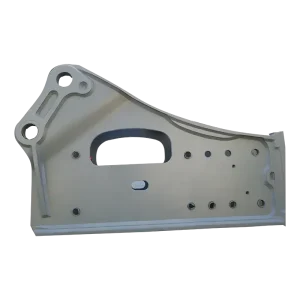
A useful factory evaluation should follow the hydraulic breaker housing project itself rather than a generic supplier audit. The most relevant question is whether the factory can review, manufacture, inspect and control the exact combination of welded structure and machined interfaces defined by the buyer.
Before approving a supplier, review how it handles drawing revision, technical questions, material substitutions, process planning, critical-interface machining, first-article inspection, nonconformance and packaging. Ask for a sample technical response to the RFQ: which features does the factory classify as fit-critical, what manufacturing assumptions has it made, and what information does it still need from the buyer?
The target Hydraulic Breaker Housing page can be used as the product reference for WLD’s construction-machinery structural component scope. The current client data supports WLD’s positioning as an OEM manufacturer of machinery structural components based on customer drawings, but it does not provide evidence for a specific material grade, tolerance capability, inspection equipment, certification, lead time or production capacity for this housing. Those items should therefore be confirmed project by project.
For supplier comparison, a practical evaluation can be organized around:
- technical interpretation — does the factory identify missing or conflicting drawing information before quoting;
- scope control — does the quotation clearly separate fabrication, machining, supplied components and exclusions;
- interface control — does the proposed process protect the fit-critical geometry defined by the drawing;
- inspection logic — are inspection points linked to the buyer’s critical dimensions and acceptance plan;
- change control — are substitutions and deviations submitted before production or shipment;
- delivery protection — does packaging protect machined and assembly-critical surfaces.
Once the drawing package and evaluation criteria are controlled, buyers can submit the project through WLD’s contact and RFQ page with the housing drawing, required manufacturing scope and acceptance expectations already defined.